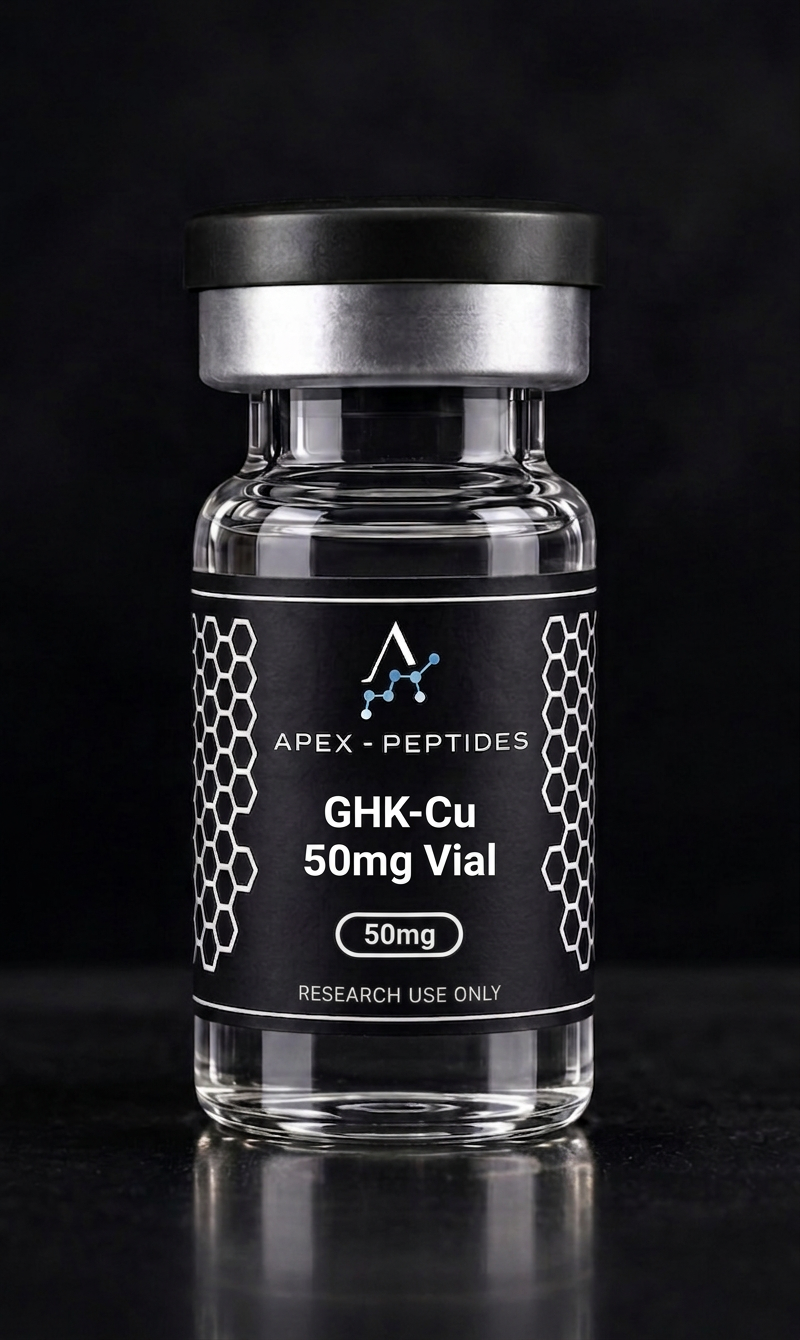
GHK-Cu - Skin Repair Collagen Peptide
Research compound of GHK-Cu - Skin Repair Collagen Peptide.
- Purity
- ≥99%
- Form
- Lyophilised powder
- Storage
- - 20 Long Term. 2-8 Reconstituted
- Testing
- HPLC + Mass Spec, COA per batch
Not sure what you need? use our peptide reconstitution calculator
About GHK-Cu - Skin Repair Collagen Peptide
GHK-Cu is a naturally occurring copper-binding tripeptide studied in extracellular-matrix signaling, collagen-related pathways, antioxidant defense, and tissue remodelling. Human studies provide topical and wound-care context, while an animal wound model provides local-administration context. Potential Benefits & Observed Effects Findings reported in the GHK-Cu research literature. * Supports research into collagen-related signaling, extracellular-matrix remodeling, and tissue repair. * Human topical and wound-care studies have examined skin and tissue outcomes in formulation-specific settings.
WHAT THE RESEARCH SHOWS
GHK-Cu (Glycyl-L-Histidyl-L-Lysine copper) is a naturally occurring tripeptide with a high affinity for copper ions, first isolated from human blood plasma in 1973 by Dr. Loren Pickart. Plasma levels of GHK naturally drop by more than 60% as we age (from roughly 200 ng/mL at age 20 down to ~80 ng/mL by age 60), which sparked decades of research into its regenerative and anti-aging properties. Here is what the published research shows:
* Massive Gene Expression "Reset":
* Genomic research (including data analyzed using the Broad Institute's Connectivity Map) revealed that GHK-Cu can upregulate or downregulate over 4,000 human genes. It effectively resets gene expression profiles toward a younger, healthier state—ramping up genes responsible for DNA repair, antioxidant production, and protein synthesis while silencing pro-inflammatory and metastatic genes.
* Collagen, Elastin & Matrix Remodeling:
* GHK-Cu is one of the most potent known stimulators of fibroblast activity. Studies show it dramatically increases the synthesis of Type I and Type III collagen, elastin, proteoglycans, and glycosaminoglycans (like hyaluronic acid).
* Beyond just making collagen, it regulates matrix metalloproteinases (MMPs) and their inhibitors (TIMPs). This balance is critical: it breaks down stiff, dysfunctional scar tissue while replacing it with organized, healthy structural tissue.
* Accelerated Wound Healing & Angiogenesis:
* Research shows it speeds up wound closure by attracting immune cells (macrophages and mast cells) to injured tissue, stimulating micro-capillary formation (angiogenesis), and rapidly re-epithelializing damaged skin, tendons, and mucosal linings.
* Hair Follicle Enlargement & Growth:
* In hair research, GHK-Cu has been shown to stimulate follicular cell proliferation, increase hair follicle size, and lengthen the active growth (anagen) phase. Some head-to-head preclinical studies showed follicular growth rates comparable to minoxidil, largely driven by improved local microcirculation and reduced scalp inflammation.
* Antioxidant & Anti-Inflammatory Defense:
* GHK-Cu blocks the release of inflammatory cytokines (such as TNF-α and IL-6) and quenches toxic products of lipid peroxidation. It also binds to free iron species, preventing harmful iron-driven oxidative stress in damaged tissue. The Bottom Line: While GHK-Cu is incredible for skin remodeling, hair health, and collagen production, it truly shines when stacked for recovery. If your goal is systemic healing, joint recovery, or tissue repair, the GLOW combo (BPC-157 + TB-500 + GHK-Cu) is the gold standard 3-in-1 blend. BPC-157 builds the blood vessels, TB-500 mobilizes repair cells, and GHK-Cu provides the collagen remodeling backbone for complete tissue restoration.
STUDIES
Maquart et al., 1993 (Journal of Clinical Investigation, France). In rat wound chambers, GHK-Cu increased collagen in a dose-dependent way, stimulating collagen synthesis twice as much as other proteins. PDF
Badenhorst et al., 2016 – randomized, double-blind facial trial (New Zealand). Women applied GHK-Cu in a lipid nano-carrier to the face twice daily. Wrinkle volume fell by 31.6% (p=0.004) compared with Matrixyl 3000, a commercial peptide used as the comparator. In lab tests, GHK-Cu also increased collagen and elastin production.
Reviews (for background)
- Pickart & Margolina, 2018 (International Journal of Molecular Sciences). This covers effects on gene expression, collagen and elastin, wound healing, and anti-inflammatory activity. Note that Pickart discovered GHK-Cu and has commercial ties to it. Full text (PMC)
- Pickart et al., 2015 (BioMed Research International). This reviews GHK’s role in skin regeneration. Full text (PMC)
Lyophilised powder