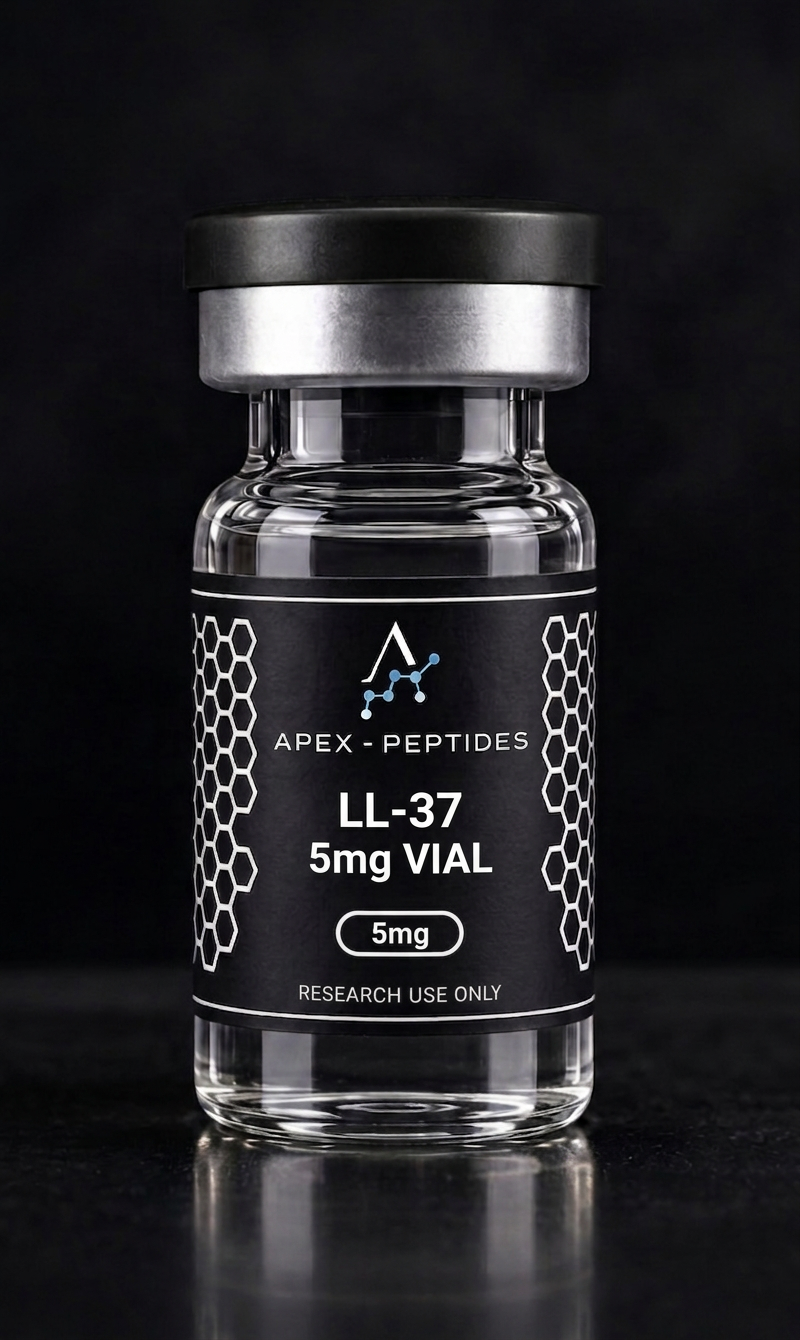
LL-37 - Anti Pathogen Healing Peptide
Research compound of LL-37 - Anti Pathogen Healing Peptide.
- Purity
- ≥99%
- Form
- Lyophilised powder
- Storage
- - 20 Long Term. 2-8 Reconstituted
- Testing
- HPLC + Mass Spec, COA per batch
Not sure what you need? use our peptide reconstitution calculator
About LL-37 - Anti Pathogen Healing Peptide
LL-37 is a 37-amino-acid peptide and the only human member of the cathelicidin family of host-defence peptides. It is cleaved from its precursor protein, hCAP-18, and gets its name from its first two residues (two leucines) and its length. It forms an amphipathic alpha-helix, a structure that lets it interact with and disrupt microbial membranes. In laboratory research, LL-37 is widely studied for: its broad-spectrum antimicrobial activity against bacteria, fungi and enveloped viruses its ability to disrupt and prevent biofilms its immunomodulatory signalling, including effects on inflammation and immune-cell recruitment its role in wound-healing and tissue-repair models
WHAT THE RESEARCH SHOWS
Biofilms & Pathogens: Studies show it physically disrupts bacterial cell membranes and effectively breaks down protective biofilms from stubborn pathogens (like Pseudomonas aeruginosa and Staphylococcus aureus*).
* Gut Barrier Integrity: Research highlights its role in protecting the mucosal lining and balancing microflora, though studies also note excessive levels can trigger local irritation or worsen active colitis.
* Immune Regulation: It acts as an immune "alarm," recruiting T-cells and fighting infection. However, clinical studies show a potential double-edged sword: chronically elevated levels are linked to autoimmune issues like rosacea and psoriasis.
STUDIES
- First-in-human trial (2014, Sweden). This randomised, double-blind trial treated 34 people with hard-to-heal venous leg ulcers. LL-37 was safe and well tolerated.
- The two lower doses markedly shrank the ulcers: average area fell 68% at 0.5 mg/mL and 50% at 1.6 mg/mL.
- Healing rates were roughly 6 times higher than placebo at the lowest dose (statistically significant, p = 0.003) and 3 times higher at the middle dose.
- The sponsor noted it’s rare for a drug to show statistically verifiable results in such a small study, especially for leg ulcers.
- Natural role in wound healing. The body makes plenty of LL-37 at the edge of fresh wounds but very little in chronic wounds, which suggests it plays a part in normal healing.
- Survives chronic wound conditions (2011, Denmark). LL-37 held up surprisingly well in fluid taken from non-healing leg ulcers. The researchers concluded that the environment of chronic wounds shouldn’t stop it from working as a topical treatment.
- Attacks bacteria and biofilms. LL-37 kills a wide range of bacteria, both Gram-positive and Gram-negative, and also breaks down biofilms (protective layers bacteria form). In lab tests it can clear biofilms that have already formed.
- That makes it a candidate for infected wounds with several bacteria, including drug-resistant ones such as MRSA.
- Broad activity. Reviews describe antibacterial, antifungal and antiviral activity. It also helps wounds heal by working with the immune system, encouraging new blood vessel growth and promoting skin regrowth over the wound.
LINKS
- Grönberg et al. 2014 – LL-37 in venous leg ulcers (PubMed)
- Pergamum – Final Phase I/II data
- HEAL LL-37 Phase IIb trial (DiVA)
- EU Clinical Trials Register – Phase IIb results
- Grönberg et al. 2011 – LL-37 stability in chronic wounds
- Grönberg et al. 2011 – Acta Dermato-Venereologica
- Duplantier & van Hoek 2013 – LL-37 for infected wounds (PMC)
- Duplantier & van Hoek 2013 – Frontiers in Immunology (PDF)
- Duplantier & van Hoek 2013 – Frontiers in Immunology (full text)
- Nurhikmah & Syah – LL-37 review (Farmaka)
Lyophilised powder